
 Our Answers: Financial Blog
Everyone has financial goals. Some are short-term, like paying down debt or building an emergency fund. Others are long-term, like buying a home or saving for retirement. The Financial Goals Planner helps you stay organized, focused, and motivated throughout the year.
This planner is built to guide you step by step. It helps you turn intentions into action and stay on track through every season.
Here’s what you’ll find inside:
Each quarter has a different focus:
Whether your goals are short-term or long-term, your plan matters. Each action helps you move forward with clarity and purpose. The Financial Goals Planner gives you a simple, structured way to stay on track and feel confident about your financial journey all year long.
Supporting teams with ongoing education builds morale and engagement. Contact us to explore ways to keep employees connected with valuable resources.
Brandon Nicklas
3407 Knipp Dr. Jefferson City, MO 65109
573-893-5929
brandon@nicklasfinancial.com
Securities and Advisory Services offered through LPL Financial, a Registered Investment Advisor Member FINRA/SIPC.
In today’s evolving benefits landscape, retirement plan success could hinge on effective strategies. This quarter’s newsletter highlights three areas plan sponsors can’t afford to overlook:
Explore advanced savings vehicles designed to support your most valued employees as they prepare for retirement. From cash balance plans to tax strategies and plan structure alignment, there are numerous options that align with executive needs and tax efficiency.
With more employees seeking financial advice from digital sources like TikTok and Reddit, it’s never been more important to provide personalized education. Learn why one-on-one guidance remains essential and how modernizing your approach can boost engagement and retention.
Data security is more than an IT issue; it’s a fiduciary responsibility. Discover how breaches impact your company and compliance. Access a cybersecurity checklist that can help you build a strong policy to protect participant data and plan assets.
Read this quarter’s newsletter for actionable tips.
3407 Knipp Dr. Jefferson City, MO 65109
573-893-5929
brandon@nicklasfinancial.com
Securities and Advisory Services offered through LPL Financial, a Registered Investment Advisor Member FINRA/SIPC.
This information was developed as a general guide to educate plan sponsors and is not intended as authoritative guidance or tax/legal advice. Each plan has unique requirements, and you should consult your attorney or tax advisor for guidance on your specific situation.
©401(k) Marketing, LLC. All rights reserved. Proprietary and confidential. Do not copy or distribute outside original intent
Practical steps to help protect participants’ data and meet your fiduciary duties.
As a retirement plan sponsor, you are juggling plenty of responsibilities. Investment oversight, fee monitoring, participant education… the list goes on. Now there’s another item on your priority list: cybersecurity.
If you’re thinking “cybersecurity is an IT issue,” you’re not alone. Many plan sponsors assume data protection falls outside their wheelhouse. But when it comes to your 401(k) plan, cybersecurity is very much a fiduciary responsibility, and it’s one that can have serious consequences if you don’t address it properly.
Retirement plans contain exactly the type of information cybercriminals value most. Think about the sensitive information stored in your plan’s database:
This treasure trove of personal and financial data represents a one-stop shop for identity theft and financial fraud.
The substantial assets held in retirement accounts also make them attractive targets. With the average 401(k) balance continuing to grow, and many accounts holding six-figure sums, the potential payoff for successful cyberattacks keeps increasing.
The DOL has made it clear that cybersecurity falls squarely within plan sponsors’ fiduciary duties. The agency’s updated 2024 guidance confirms that all ERISA plans must have appropriate cybersecurity measures in place to protect participants and beneficiaries from cybercrimes.
This means that plan sponsors must exercise the same level of prudent oversight for cybersecurity as they do for investment selection and fee monitoring. Plan sponsor compliance isn’t just checking boxes; it’s demonstrating that you’re taking reasonable steps to protect participant information and plan assets.
The good news is that effective cybersecurity doesn’t require you to become a technical expert. It does, however, require a systematic approach and attention to key areas that can significantly reduce your risk.
Most plan sponsors rely on recordkeepers, payroll companies, TPAs, and other providers. Since these vendors have access to participant data, their cybersecurity practices directly affect your plan’s exposure to potential risks.
When choosing a vendor, ask specific questions. Check their security measures, certifications, and incident handling. Don’t hesitate to ask the tough questions; your fiduciary duty requires this level of due diligence.
Keep tabs on your providers’ security through regular updates and audit report reviews to help confirm they have proper protections in place. Make sure your service contracts include clearly- defined cybersecurity requirements and detailed notification procedures for any security incidents.
A well-documented cybersecurity policy provides detailed guidance for employees, demonstrates your commitment to data protection, and can be valuable evidence of prudent fiduciary oversight.
Your cybersecurity policy should include these essential action components:
Effective cybersecurity requires buy-in from your entire organization, not just the IT department. Leadership support demonstrates the importance of data protection and helps allocate resources for security initiatives.
Regular communication about cybersecurity threats and best practices helps to promote security awareness.
When cybersecurity becomes part of your culture, your potential risks decline significantly.
Implementing cybersecurity measures and staying current with evolving regulatory requirements may seem daunting, but keep in mind that you don’t have to go it alone. Many plan sponsors find that working with experienced advisors and cybersecurity professionals helps them to develop appropriate protection measures without getting overwhelmed by technical details.
Start by honestly assessing your current cybersecurity practices. Review your existing policies, evaluate your service providers’ security measures, and identify any obvious gaps in protection.
________________________________________
Securities and Advisory Services offered through LPL Financial, a Registered Investment Advisor Member FINRA/SIPC.
This information is provided as a general guide to educate plan sponsors. It is not intended as authoritative guidance or tax/legal advice. Each plan has unique requirements, and you should consult your attorney or tax advisor for guidance on your specific situation.
©401(k) Marketing, LLC. All rights reserved. Proprietary and confidential. Do not copy or distribute without permission.
Retirement Transition: More Than Just Finances
Retirement is more than just a financial decision; it’s a major life transition. This presentation explores how to prepare emotionally and practically, covering purpose, connection, structure, and planning. The goal is to have real conversations around the emotional impact this major life transition can have on you, so that you are more prepared.
Watch the Video:
This short video discusses 5 key action areas:
You can also download this practical guide to help yourself or others prepare for retirement by focusing on the emotional and lifestyle aspects of the transition, and not just finances. It includes prompts and tools to support self-reflection, connection, purpose, structure, and aligning daily life with long-term goals.
Designed to empower near retirees with clarity and confidence, it complements financial planning with personal readiness.
Looking for More Employee Education?
Supporting teams with ongoing education builds morale and engagement. Contact us to explore ways to keep employees connected with valuable resources.
Why human-led employee education still matters
It’s wonderful to live in a time when answers are just a click away. You can easily find out how many inches are in a meter, get TV show recommendations, and find out where the next Olympic Games will happen. But when it comes to financial advice, the internet becomes a far riskier place.
From TikTok tips to viral Reddit threads, employees are consuming an overwhelming amount of financial content, and not all of it is accurate. In fact, much of it can be misleading, incomplete, or flat-out wrong. And while younger generations are the most likely to seek out this digital advice, they’re also the most vulnerable to its consequences.
Social media platforms and influencer content are not inherently bad, but they are unregulated. Anyone with a camera and confidence can offer “advice” without any credentials. This opens the door to the kind of misinformation that can lead employees to make costly mistakes.
It’s especially concerning for younger employees. A recent survey found that 49% of Gen Z and 43% of millennials have sought financial advice on social media. Top sources for digital advice are Facebook, Instagram, TikTok, Twitter/X, and financial influencers from other platforms.1 This may makes them more susceptible to making costly financial decisions, such as buying into trendy “get rich quick” schemes, misusing credit, or delaying critical savings milestones like retirement contributions.
While it’s easy and convenient to look online for financial advice, the information found may be incomplete, misleading, or inaccurate.
“While some platforms have added disclaimers or warning labels on financial advice content…the risk of making misguided investment decisions due to misinformation and fraud is greater than the risk would be if the advice was taken from traditional advice channels. In the first six months of 2023, the Federal Trade Commission reported losses totaling $2.7 billion from investment-related fraudulent scams initiated on social media in the US alone; 37% of those fraud losses were reported by investors aged 20-29,” explained the World Economic Forum. [1]
When your employees receive and act on poor financial information, it can have a detrimental effect on financial wellness. Workers who are financially stressed may become less engaged and less productive – and that can hurt employers.
| Source | Personalized to Individual | Risk of Misinformation | Supports Financial Wellness | Looks to Improves Productivity |
| Financial Advisors | Yes | Low | Yes | Yes |
| Social Media & Unlicensed Influencers | No | High | Possibly | Possibly |
While employees will continue to seek advice online, it’s possible to help them avoid costly errors by offering in-person financial education at work. A licensed financial professional can engage employees through group meetings or one-on-one sessions. Either possibility will give employees opportunities to:
When employers want to deliver financial education that supports financial wellness and retirement outcomes, partnering with a retirement plan advisor makes a real difference. Advisors can deliver robust financial education programs and fill education gaps with tailored, relatable content that can improve employee decision-making and overall financial wellness.
If you would like a complimentary consultation or a demonstration of our services, please get in touch. We are experienced employee educators who understand the importance of financial wellness.
[1] Aru Bhat and Sofia Eckrich. “Are ‘finfluencers’ the future of financial advice?” World Economic Forum. July 17, 2024. Cited June 27, 2025.
Securities and Advisory Services offered through LPL Financial, a Registered Investment Advisor Member FINRA/SIPC.
This information is provided as a general guide to educate plan sponsors. It is not intended as authoritative guidance or tax/legal advice. Each plan has unique requirements, and you should consult your attorney or tax advisor for guidance on your specific situation.
©401(k) Marketing, LLC. All rights reserved. Proprietary and confidential. Do not copy or distribute without permission.
The following limits are going up for 2026:
Review the full list of contribution limit changes below and share with your plan participants!
Want fewer questions and better outcomes during plan changes? Start with clear, step-by-step communication.
A strong participant communication checklist helps plan sponsors share plan updates clearly, confidently, and on time. When your retirement plan changes, knowing how and when to communicate is essential.
From legal notices to plain-language updates, plan sponsors have a lot to manage. Participants need accurate, timely information to understand what’s changing and how it will affect them.
That’s why this checklist focuses on helping you:
Good communication builds trust. It also supports your fiduciary responsibilities and helps employees stay engaged with their retirement benefits.
If your plan has updates coming soon, or you want to strengthen your communication process, this checklist is a simple, valuable place to start.
Download the checklist to help streamline your next plan communication.

Elevating the value of your retirement Plan
Imagine this: It’s year-end and your CPA just reviewed your projected tax bill. Despite contributing to your 401(k), maximizing deductions, and running a profitable business, you’re still writing a sizable check to the IRS. You pause and think, there has to be a better way.
If this sounds familiar, you’re not alone. Many high-income business owners, CFOs, and executives find themselves hitting the ceiling of traditional planning, maxing out the basics while still exposed to significant state and federal tax burdens that erode long-term wealth.
The solution? Transform your company-sponsored retirement plan into a tax-smart, strategic tool. By applying advanced tax strategies, you can elevate your plan from a standard benefit into a strategy for wealth accumulation and executive retention. If you already sponsor a 401(k) plan, you’ve laid the foundation. But unlocking its full potential, especially for high earners, requires advanced plan design.
Whether your company has a new plan or $500 million in plan assets, strategic enhancements can help you defer significantly more income, reduce taxable income, and reinvest back into your people and your own future.
Most plans include matching contributions, but there’s significantly more opportunity when you integrate a profit-sharing component. With the right allocation formula, such as New Comparability or Age-Weighted methods, you can direct larger contributions to key executives while satisfying compliance testing.
According to the Voice of the American Workplace 2025 study by Franklin Templeton, 41% of employers already offer profit-sharing and 66% offer a 401(k) match, with the average match capping at 25% of employee contributions.[1] How does your plan compare?
With this structure, high-income earners could realize up to $70,000 (or $77,500 for ages 50–59 or 64+, $81,250 for ages 60–63, if your plan allows) is available in total annual contributions including employee deferrals, catch-up contributions, employer match, and profit-sharing, significantly more than what a standard employee can defer, all while reducing taxable income.
[1]Franklin Templeton. “Voice of the American Workplace.” 2025.
If your company has strong cash flow and steady profits, a Cash Balance Plan can take your retirement and tax strategy to the next level.
When paired with a 401(k), it allows much higher contribution limits, often over $300,000 per year, depending on the owner’s age and income. All contributions are tax-deductible to the business, making it a smart way to reduce taxable income while building long-term wealth.
Cash Balance Plans are especially effective for:
Today’s top talent, especially in leadership roles, expects more than a simple match. Advanced plans can offer:
If you operate as an S-Corp or partnership, every dollar you contribute for owners and key employees not only reduces corporate taxable income; it often lowers pass-through income, impacting individual taxes as well. Layering tax-deductible contributions into the right structure helps balance short-term tax savings with long-term wealth building.
If it’s been more than a year since your plan design was reviewed, you may be leaving value on the table. Today’s optimized plans are:
You’ve already invested in your 401(k) plan. Now’s the time to confirm it’s working just as hard as you are, helping you defer more income, retain your top people, and reduce tax exposure along the way.
Talk to us about profit-sharing modeling, cash balance plan layering, and owner-weighted strategies that help to deliver maximum value.
________________________________________

Brandon Nicklas
3407 Knipp Dr. Jefferson City, MO 65109
573-893-5929
brandon@nicklasfinancial.com
Securities and Advisory Services offered through LPL Financial, a Registered Investment Advisor Member FINRA/SIPC.
This information is provided as a general guide to educate plan sponsors. It is not intended as authoritative guidance or tax/legal advice. Each plan has unique requirements, and you should consult your attorney or tax advisor for guidance on your specific situation.
©401(k) Marketing, LLC. All rights reserved. Proprietary and confidential. Do not copy or distribute without permission.
According to the Identity Theft Resource Center, the annual number of records exposed rose 126% in 2018, even while the annual number of data breaches fell by 23%. The business sector experienced 46% of the data breaches in 2018, followed by the medical and health care sector at 29%.1
This crime occurs when a thief obtains confidential information — including passwords, personal ID numbers, Social Security numbers, or an account number used with a financial institution — and uses it to commit fraud. Identity thieves use a victim’s stolen information to open bank and brokerage accounts, run up bills for credit card purchases, obtain loans, and commit other forms of financial fraud.
Criminals obtain a victim’s personal information in a number of ways — both online and off. But as incidents of identity theft grows, so too does the arsenal of tools and sophistication level of techniques used to perpetrate the crimes.
Although online crime is a fast-moving target, currently, the primary methods in use by identity thieves are social engineering and phishing — or typically a combination of both.
As the term implies, social engineering relies heavily on human interaction and often involves tricking unsuspecting victims into breaking normal security procedures. In short, it is a way for criminals to gain access to your computer or mobile device and the sensitive personal data it stores. For instance, a social engineer may use text messaging to contact a mobile device inviting the user to click on a link to a bogus website where the thieves collect user credentials and other personal information.
Similar results can be achieved through a phishing attack, in which the criminal uses email to lure victims to fake websites and then gain access to their passwords and usernames, credit card numbers, and other key data. Phishing emails often appear to be from a legitimate company that the victim recognizes.
In yet another instance, attackers may inject infected “malicious” code onto your computer via email attachments, links contained in emails, infected search engine results, or through videos and documents on legitimate websites, particularly social networking sites. In the mobile device world, criminals can corrupt a legitimate smartphone app and upload it to a third-party site. If users innocently install the app, they expose their devices to assaults by hackers who collect personal user data, change device settings, and sometimes even control the device remotely.
In today’s 24/7/365 world, it is nearly impossible to secure all sources of personal information that may be “out there” waiting to be intercepted by eager thieves. But you can help minimize your risk of loss by following a few simple hints offered by the Federal Bureau of Investigation (FBI):
Finally, be very wary of any email or text message expressing an urgent need for you to update your personal information, activate an account, or verify your identity. Practice similar caution with email attachments and downloadable files and keep your computers protected with the latest security updates and virus protection software.
Source/Disclaimer:
1Identity Theft Resource Center, 2018 End-of-Year Data Breach Report, 2019.
Required Attribution
Because of the possibility of human or mechanical error by DST Systems, Inc. or its sources, neither DST Systems, Inc. nor its sources guarantees the accuracy, adequacy, completeness or availability of any information and is not responsible for any errors or omissions or for the results obtained from the use of such information. In no event shall DST Systems, Inc. be liable for any indirect, special or consequential damages in connection with subscriber’s or others’ use of the content.
© 2020 DST Systems, Inc. Reproduction in whole or in part prohibited, except by permission. All rights reserved. Not responsible for any errors or omissions.

Updated April 1, 2020
CARES Act Legislation Summary
On March 27, 2020, the Coronavirus, Aid, Relief, and Economic Security (CARES) Act (the “Act”) was signed into law. A portion of the Act is intended to loosen access to retirement plan funds for individuals impacted by the COVID-19 pandemic. The following is a summary of the retirement-related provisions of the Act:
Plans can adopt the new rules immediately. The plan will eventually need to be amended on or before the last day of the first plan year beginning on or after January 1, 2022, or later if prescribed by the Secretary of the Treasury.
For any questions related to the CARES Act, your plan, or how it impacts your employees and participants, please do not hesitate to contact us.
Source: https://www.napa-net.org/sites/napa-net.org/files/CAREs%20Act%20revised_032220.pdf
Securities and Advisory services offered through LPL Financial, a registered investment advisor. Member FINRA/SIPC
ACR#345807 4/20
During times of uncertainty and market volatility, while it is prudent for plan participants to “stay the course”, it is also prudent for them to review their investment strategies to ensure they are on the most appropriate path. Follow the link below to read more.
As a child I often heard my dad saying, “What’s fair isn’t equal and what’s equal isn’t fair.” Most times he said this in response to my complaints about the unfairness of something I was having to do (usually centered on chores I had to do that my sisters did not). I always thought that was a dumb statement because it meant I wasn’t getting out of my chores, but as I’ve grown older I have seen the truth in what he said. Fairness and equality are rarely synonymous.
When it comes to the fees and expenses associated with your retirement plan both fairness and equality must be considered when determining the reasonableness of the plan’s pricing. In recent years most plan sponsors have focused almost entirely on whether their plan was priced fairly. This has been accomplished for the most part through advisors and recordkeepers soliciting business based on lower total cost and to a lesser extent through fee benchmarking. While ensuring that a plan is fairly priced is important, what’s lost in many of these comparisons is the fee structure, which addresses the who, what and how the fees and expenses are paid. This is the equality component of reasonableness.
Broadly speaking, there are two types of expenses in a retirement plan, investment expense and administrative expense. Investment expenses are directly related to the investment alternatives (most of the time mutual funds) chosen by each participant in the plan. Each investment alternative has its own expense, which pays for the operation and management of the assets in that fund, and that expense is deducted from the earnings. These expenses can and will vary based upon how each participant chooses to invest their assets. Administrative expenses, as the name implies, cover the administrative activities of operating a retirement plan such as recordkeeping, technology, compliance, participant communication, etc. These expenses should not vary based upon a participants investment choices because the cost to administer the plan is the same regardless of how a participant chooses to invest their assets.
If a plan sponsor has never inquired about how the administrative expenses are paid there may be inequity in the expense paid by participants, meaning some participants may be paying a disproportionate share based upon their investment choices. Fee equalization or fee levelization is an approach to provide a more equitable sharing of administrative expenses and many times greater fee transparency as well. There are several fee levelization strategies that can be implemented based upon your plan’s current situation and recordkeeper. If you have never looked at the structure of your plan’s fees and expenses we recommend asking your recordkeeper or advisor about fee equalization.
While fairness and equality might not be the same, it’s important for plan sponsors to look at both when analyzing plan fees, so participants pay a fair price and share more equally in the cost of administering this important benefit.
Securities and Advisory Services offered through LPL Financial, a Registered Investment Advisor. Member
FINRA/SIPC. Registered branch address is 3407 Knipp Dr, Jefferson City, MO 65109. (573) 893-5929.
We have been taking our clients plans to live bid on a 36 month cycle for the last 12 years, it’s actually a part of our service plan. The results of those bid proposals, in terms of potentially decreased expenses to participants and/or increased provider services, cannot be overstated. But the last 18 months has presented 3 opportunities that plan sponsors should consider capitalizing on because once gone, we may not see again for a long time.
Over the last 6 months we have seen plan sponsors have more successful outcomes in reducing plan expenses due to live bid RFP’s. Additionally, live bid RFP’s can provide valuable information to plan sponsors when negotiating with their current service providers.
If you have never taken your plan out to a live bid RFP or if it’s been a while, NOW IS THE TIME! The stars are aligned to create a potentially great opportunity for your retirement plan participants. Remember, every dollar saved in expense is a dollar left in participant accounts with the potential to compound for their retirement.
Securities and Advisory Services offered through LPL Financial, a Registered Investment Advisor. Member
FINRA/SIPC.
The popular phrase “perception is reality” is often used to express the idea that how things really are is based on a person’s perspective. While this may be true in certain areas of life, this statement is simply not true when it comes to retirement planning. Plan sponsors often make assumptions regarding their employees’ levels of understanding on various aspects of retirement planning. Such aspects include an employee’s understanding of available plan investment options, individual retirement goals, savings requirements, and plan effectiveness. Consequently, plan sponsors must ask themselves, “Does my perception of plan participants’ understanding of retirement goals and investment options match up with their reality?” The truth is, perceptions of plan sponsors are often inconsistent with what their participants truly think. In fact, a recent study conducted by BlackRock and published in their 2016 DC Pulse found that the discrepancies can be quite stark between plan sponsors’ perceptions and the reality of what participants actually think about their retirement plan.
For instance, one of the most important issues for employees to consider regarding retirement planning is whether or not they are saving enough to have a secure retirement. *BlackRock’s survey found that while 59% of plan sponsors believed the majority of their plan participants’ savings were adequate, only 28% of employees thought they were saving enough. The survey results also revealed a large perception gap in the number of participants who knew how much money they would need during retirement: 64% of plan sponsors thought their employees understood the amount of money necessary to achieve their retirement goals whereas only 37% of employees responded that they understood. Plan sponsors significantly overestimate their employees’ understanding of plan investment options as well with 67% of plan sponsors responding they think their participants understand their investment options. Not surprisingly, only 43% of participants felt they understood the investment options offered by their plan.
The fact that plan sponsors and employees report such drastic differences should alert sponsors that they are likely operating from inaccurate perceptions of their participants. These differences can lead to frustrations for both plan sponsors and participants when plans do not adequately meet participant needs. But the good news is by pinpointing these misperceptions plan sponsors can implement strategies to correct them more effectively. Now more than ever participants are looking for help when it comes to retirement savings. Only one out of three participants are satisfied with plan support for monitoring and changing their savings rates and 42% would be interested in getting help determining how much they should contribute to their plan.
These survey results should motivate plan sponsors to re-evaluate whether or not their assumptions are consistent with their participants’ actual experience. By better understanding the participants’ perceptions, plan sponsors can implement strategies in seeking to make more meaningful improvements to their participants’ retirement outcomes.
*Source for all data: BlackRock DC Pulse Survey, September 2015. The conclusions are intended to provide an indication of the current attitudes of a sample of U.S. plan sponsors and participants about retirement saving and investing and should not be relied on for any other purpose.
Securities and Advisory Services offered through LPL Financial, a Registered Investment Advisor. Member
FINRA/SIPC.
There is a lot to love living in Missouri. If you take just a little time to research the history and geography or our state you will find it is a very unique and special place. We have incredible diversity of terrain, people, culture, and climate. I love driving around the state and experiencing the abundance of different activities, food, drink, and people along the way. I take particular pride in our state nickname, the “Show Me State.” We have a pioneering history of perseverance, hard work, and getting the job done. Around here talk is cheap, we want proof. Because success is measured in outcomes, which brings me to the point I really wanted to address: measuring outcomes.
In past articles I talked about creating the “best” retirement plan, one that seeks to create successful outcomes for employee participants. Part of creating the best plan is tracking and measuring how successful your plan is at getting participants financially prepared for retirement. In other words, as a plan sponsor you should be able to demonstrate, or “Show Me,” the effectiveness of your plan. More importantly, as a plan sponsor you should be able to “Show” your participants if they are on track for their retirement goals. Unless you measure something it is very difficult, if not impossible, to improve it in a significant way. Karl Pearson, the founder of mathematical statistics, said, “That which is measured improves. That which is measured and reported improves exponentially.” In your retirement plan, measurement and reporting is critical to creating successful outcomes. Plan design, investment alternatives, plan administration, and participant education and communication are all areas that should be frequently reviewed and measured for how effective they are at pursuing retirement goals for participants.
Now more than ever plan sponsors should embrace and champion the “Show Me” mantra. Technology has made measuring and reporting plan and participant level information much easier. As a plan sponsor you should look to your service providers to provide you information on overall plan health, which not only looks at participation and deferral rates, but more importantly identifies how many participants are on track to meet their retirement income needs. By measuring and understanding plan health you can identify and implement changes at the plan level in seeking to help improve participant outcomes. Your service providers should also be able to assist you in providing participants with personalized retirement income projections on a consistent basis. “Showing” participants where they are and whether they are on track to meet their retirement income needs helps them make more educated decisions about their retirement savings and in many cases leads to increased deferral rates and more participation.
While at a Naval banquet in 1899, Congressman Willard Vandiver famously declared that “I come from a state that raises corn and cotton, cockleburs and Democrats, and frothy eloquence neither convinces nor satisfies me. I’m from Missouri, and you have got to show me.” It’s time to stop talking about successful retirement plans and to start proving it. I encourage you as a plan sponsor in 2016 to challenge your service providers to “Show Me” how successful your plan is at preparing your participants for retirement.
Securities and Advisory Services offered through LPL Financial, a Registered Investment Advisor. Member
FINRA/SIPC.
Ringing in the New Year should bring with it the optimism of being part of a better future. Whether you are pursuing a better future with your health or with your finances we recommend addressing these three questions.
First, Where am I now? Without a true understanding of your current position you will most likely not move in the most effective direction toward your better future. I’ll use the example of travel. Think about being in a large city with a limited amount of time to enjoy the sites and the people. Without knowing exactly where you are located you are unable to create a plan to get to where you want to go and you lose precious time and possibly enjoyment of your potential future Take a thorough assessment of where you are today and record it so you work toward your better future.
Second, Where do you want to be? Answering this question may require more time and thought. A quick, off the cuff answer such as, “Not where I am today,” will potentially cause pursuit of an unknown destination, leaving you no closer to your better future than you are today and worse, you may be further away.
And finally, What’s stopping you from getting there? We all have infinite lists of why nots, a few are valid but many are just excuses. Make a list of all the roadblocks and obstacles that are potentially slowing you down or stopping you completely. Are there ways around the obstacles or detours that you can take to get you to your destination? Or do you need help from others to remove the roadblocks? Just like a GPS unit warns you about road construction or traffic jams ahead of time, it is critical to identify what’s in your way so you can determine an alternate route or perhaps a solution to overcome the obstacle.
Answering these questions helps you chart the route to your better future. Then you can begin to enjoy the journey, celebrating each new attraction (achievement) and relationship made along the way. We, at Nicklas Financial, welcome the opportunity to join you in pursuit of your better financial future.
Always remember, EVERY MOVE MATTERS!
A good plan sponsor should be focused on designing and implementing a retirement plan that creates successful outcomes for employee participants. Part of that design includes features that help participants save more, remove barriers to participation, simplify decision making and accommodate specific preferences. Over 25 years of anecdotal evidence and the more recent mountain of behavioral finance research continues to highlight that participants know they need to save for retirement but fall prey to inertia. Inertia is defined as: a tendency to do nothing or to remain unchanged. When plan sponsors let their employees make enrollment and savings decisions the sponsor will struggle with lower participation rates and even lower average savings rates. This is due to financial inertia. Does that sound like a plan that is going to create successful outcomes for participants? I don’t think so.
There are at least two design features that plan sponsors can use to get employees in the plan and help them save more. But often they do not use these. They are auto enrollment and auto escalation.
Getting employees to participate in the plan is the most critical function for a plan sponsor. Savings rates and investment options are important, but if an employee never enrolls in the plan, all other issues related to the plan are moot. A plan sponsor should look to make the enrollment process as easy as possible and eliminate the hurdles that inhibit participation. Instead of requiring employees to complete and return enrollment forms or log on to a new website to complete online forms, automatic enrollment provisions allow plan sponsors to enroll every eligible employee automatically. The employee is enrolled utilizing a default deferral percentage and default investment alternative, both of which are defined in the plan document. Any employee who does not wish to participate can opt out or change default elections at any time. By reversing the enrollment process, making employees opt out instead of opt in, plan sponsors will see higher participation, will potentially increase initial savings’ rates, and most importantly encourage good savings behavior.
While automatic enrollment helps get employees in the plan, automatic escalation addresses the issue of participants not saving enough. The overwhelming majority of participants never change their deferral percentage or investment elections after the initial enrollment. Some studies place that number as high as 80%. Most participants grossly underestimate the amount of savings required to maintain their standard of living in retirement and instead base their amount of savings on the employer match. Even participants who know they need to save more find it difficult to save on their own. Automatic escalation addresses this issue by increasing participants’ contributions by a preset percentage, 1% for example, each year. This way the participants’ contributions grow without excessively impacting their take home pay. Notices distributed each year before the increase give participants the opportunity to change or opt out of the escalation.
Many times plan sponsors initially react negatively to the suggestion of making automatic decisions for employees when it comes to their paycheck and savings. But participant surveys tell us the following:
Participants know they need to save for retirement and know they likely need to save more, but they are looking for help. While auto features are not a “magic bullet,” used appropriately, they leverage participant inertia. This movement, once started, will promote and encourage good savings behavior, which should lead to more successful outcomes for participants.
Securities and Advisory Services offered through LPL Financial, a Registered Investment Advisor. Member
FINRA/SIPC.

Just kidding. I’m not retiring. I can’t afford it. But thanks for the cake with my name on it.
Have you ever reflected on your years in high school math? Take a moment and think back. Most likely you learned to solve equations for X or Y.

Geometry taught you to find the area of different shapes: triangles, rectangles, circles, trapezoids.

Maybe you even got to Calculus.
While each class deepened your knowledge of math, the numbers and methods became increasingly complicated. No doubt your teachers encouraged you with the phrase “You’ll use this again someday.”
But have you? You’re well into your career and are now able to assess the validity of that statement. Which formula has helped guide your future?
Depending on your career, the answer is likely not the formula that helped you find the length of a hypotenuse.
Take a good look at this formula. Do you recognize it?
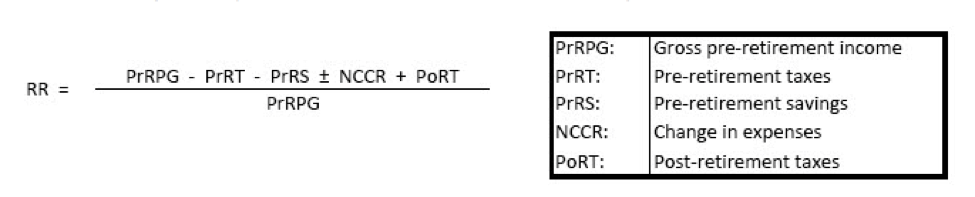
This formula can impact your life, and you never learned it in high school. This is the Replacement Ratio formula. At the most basic level, it helps you determine what percentage of your current income you will need to replace in retirement.
Spelled out it means:
Replacement Ratio = (Gross Pre-Retirement Income – Pre-Retirement Taxes – Pre-Retirement Savings +/- Change in Expenses + Post Retirement Taxes) /Gross Pre-Retirement Income
Some of the variables in the equation depend on you and your unique situation. Only you know the answers to questions like “How will my expenses change in my mid 60s?” Your healthcare will likely go up and your dependent (children) expenses will likely go down or completely disappear. Also, you can anticipate your post-retirement taxes to decrease since you won’t be earning an income.
So, why do you need to figure out your Replacement Ratio? Ideally your Replacement Ratio will help you determine your retirement plan savings rate. When you use an online financial calculator to figure out how much money you will need to have on the day you retire, one piece of the puzzle will be your Replacement Ratio. It will help you know how you can sustain the lifestyle you desire throughout retirement.

So, how much money should you be laying aside now to reach your financial goals of the future?
It’s pop quiz time. Sharpen your number two pencil and get out some scratch paper. At the top of the page write your name and this question, “Will I be retirement ready?”
Remember to show your work. You may start….now!
Securities and Advisory Services offered through LPL Financial, a Registered Investment Advisor. Member
FINRA/SIPC.
Recently, my 10 year old son finished a very successful spring season of competitive baseball. The team did well; it had a winning record, two tournament championships and a World Series event. During the season, I also saw my son learn what it takes to be the best ball player he can be. Through hard work, perseverance, listening and applying what he learned, he was able to maximize his potential. And when he was at his best, his team became better.
What does my son and his baseball team have to do with a retirement plan? Often I hear business owners talk about being the “best,” having the best product, service or technology. However, I find what makes a company the “best” is when the employees are allowed and encouraged to reach their potential. Numerous studies highlight that employee productivity and job satisfaction increase dramatically with an increased sense of financial security, yet very few employers take this knowledge and consider creating the “best” retirement plan for their employees. They seem to not see what I do: a plan allows, encourages and incents employees to be more financially secure and it is a big part of helping them maximize employee potential for the company. When the employees are at their best, the company will perform at its best too, just like my son and his team.
There is no one “best” retirement plan; each is unique and tailored. However, all “best” plans share one common theme: the employer strives to design a retirement plan that creates successful outcomes for employee participants. These plans embrace features that help participants save more, remove barriers to participation, simplify decision making and accommodate specific preferences.
“Best” plan features might include:
In considering a change to retirement plan features, employers often cite increased cost and employee pushback as the main reasons for not adopting them. However, plan features, such as the above, are key in maximizing the retirement outcomes for employees. They help employees feel more financially secure and successful, which can lead to increased satisfaction, less stress, higher productivity and lower employee turnover. While it is difficult to project the costs amended features may have on the plan, it is also important to weigh financial benefits content employees have on productivity and longevity with the company. One way to help determine the cost benefits is to work with a quality retirement plan advisor and/or TPA. Revising your plan is additional work and involves more to consider, but, in my opinion, you can’t become the best company without hard work, perseverance, listening and applying what you’ve learned.
Securities and Advisory Services offered through LPL Financial, a Registered Investment Advisor. Member
FINRA/SIPC.

The question we most often ask business owners or plan sponsors is “why do you have a plan?”
Charlie Epstein, author of Paychecks for Life — How to Turn Your 401(k) into a Paycheck Manufacturing Company, illustrates the point really well with the following scenario:
“Imagine you are about to board an airplane at Bradley International Airport. Your destination is Los Angeles. As you are checking in at the gate, the agent comes on the PA system and says, “ladies and gentlemen, I have an announcement to make. The captain and the FAA want me to let you know that there is an 85% chance that this plane will not make it to your final destination on time and safely. Have a nice flight!”
After hearing that announcement, would you board that airplane? Unless you had a death wish, I would imagine not. The probability of success (15%) is nowhere close to justifying the level of risk this scenario poses. Now, let’s land the metaphor. Replace the plane with your company-sponsored 401(k) plan. The reality is you’re “boarding” your employees and their financial future onto a plan where there’s an 85% chance they won’t successfully arrive at their destination. This is not good odds for them or a good reflection on you.
So, I’ll ask you now: why do you have a plan? If your answer is “because I have to” or “to look competitive for job-seekers,” I’m going to have to tell you that’s no longer sufficient. As a plan sponsor, you are safeguarding 401Ks, and those are the second largest asset that a participant will ever have. You need to be focused on how you can help participants be retirement ready—teaching them that every decision they make today impacts the success of their outcomes for tomorrow.
We understand managing your employees is probably not your only responsibility. You have many roles and being a plan sponsor—a good plan sponsor—can require specialized knowledge and training that may be outside of your skillset. In order to get your employees and their 401(k)s where you want them to be, you might need help. The good news is there are professionals out there who have training, knowledge and the staff to support you—including the professionals at Nicklas Financial.
We would love the opportunity to sit down with you and discuss how we can help you and your employees, but even if you’re not ready to commit to that yet, we still want to help you. In the coming months we will be doing a series of blogs providing steps that can help you put your employees on the path toward retirement readiness, so stay tuned in.
Securities and Advisory Services offered through LPL Financial, a Registered Investment Advisor. Member
FINRA/SIPC.
In our last blog post, we talked about the definition of a fiduciary and what that means in the financial services realm.
As a reminder, you are a fiduciary if you exercise discretionary control over the management of a plan or its assets—in this case we’re referring to a 401K, defined contribution or other type of retirement plan. But what does that mean, functionally?
One major problem we see all too often is that a person often doesn’t know he or she even IS a fiduciary. In this post, we’d like to go a step further and help you identify whether you are a fiduciary (just in case you’re on the fence).
So, in the spirit of the great American philosopher, Jeffrey Marshall Foxworthy, we present you with:
You Might be a Fiduciary…
If you have a vote that makes decisions about a plan or its assets (such as evaluating fund performance, fund changes, fund additions and/or vendor changes)… you might be a fiduciary.
If you’re in an official group given fiduciary duty such as Benefit/ Investment Committees, Board of Directors or Trustees… you might be a fiduciary.
If you get paid for your ideas on discretionary control… you might be a fiduciary.
If you declared, “I am a fiduciary” in writing in your role as a manager… you might be a fiduciary.
If you know what the ERISA 3(38) requirements are and you meet them… you might be a fiduciary.
If you’re a Trustee… you might be a fiduciary.
If you’re a member of the Employer’s Board of Directors… you might be a fiduciary.
If plan fiduciaries rely on your counsel (perhaps as an attorney or consultant)… you might be a fiduciary.
So, based on this list, are you a fiduciary? It’s a question worth answering. Fiduciaries are inherently in a position of power. And with power, we all know, comes great responsibility. At Nicklas, we are interested in helping you shoulder that responsibility. To discuss the fiduciary role, to determine if it is one you hold, and to outline an appropriate action steps you can take, you can contact one of us on the Nicklas team. There are no ifs for us; we want to help you.
Securities and Advisory Services offered through LPL Financial, a Registered Investment Advisor. Member FINRA/SIPC.

Hi All,
Welcome to the new Nicklas Financial blog — your resource for an inside look at Nicklas Financial and all the latest on trending topics in the financial services industry. I wanted to take this opportunity to give you a preview of some new and exciting changes for our company including our current rebranding effort.
Since we opened our doors three generations ago, a lot has changed about our industry and our company. Thus, after an evaluation of our brand, we realized that our past branding didn’t reflect who we are and what we do best.
We decided to update our brand image to properly represent our commitment to simplifying the complex world of financial services. As part of this rebranding effort, you will see a new logo, tagline, website and remodeled office!
As you may have noticed, the inspiration for the logo and tagline came from the game of chess. I’d like to share with you how we came to this decision.
First, both chess and financial services involve making sense of complex, long-term strategies.
Second, we found that masters in each area have a similar ability — to break down complex strategies into a series of small, simple and deliberate moves. These small moves are what will keep you progressing toward your end goal.
These two traits fit perfectly with our client-centric approach to financial services. Our goal has and always will be to put our clients first and to simplify the financial services process. For both individuals and businesses alike.
On behalf of the Nicklas team, I invite you to take a closer look at what today’s Nicklas Financial can do for you and reach out to us if you have any questions. Whether you’re debating your first move or closing in on your end game, we’ll be here to help you seek to plan a winning strategy.
-Kenny Nicklas
Top 10 Reasons You Should Join the Nicklas Team:
10. You’re top-notch – which is our favorite notch. We’d get along great.
9. Access to services from the nation’s largest independent broker/dealer.
8. Local attention and support. We’re not just a name and a voice you might hear over the phone every once in a while. You can come in, shake our hands and collaborate to create solutions.
7. After 35 years in the industry, we know a thing or two.
6. Compliance can seem ominous. We’ll work with you to assist with the requirements.
5. Because we strive to be top-notch. Just like you…see #10
4. You want choices and we have them. You’ll get a complete choice of flexible fee-based programs.
3. We have access to a wide variety of investment products.
2. This guy will come visit you. We promise, it’s a good thing.

1. Because being the master of your own destiny is a beautiful thing. The Nicklas Team can help you get there.
MAKE YOUR MOVE.